Wednesday, September 23, 2026

WIND POINT LIGHTHOUSE


Built of brick with an inner and outer wall, Wind Point Lighthouse gradually tapers from a diameter of twenty-two feet at its base to twelve feet eight inches at its lantern. The tower stands atop a ten-foot-deep stone foundation and measures 110 feet three inches from its base to the ventilator ball atop its lantern room. The tower features two distinctive architectural embellishments found in many of the tall towers on the Great Lakes: masonry gallery support corbels and arch-topped windows. A spiral cast-iron staircase, with 144 steps and five landings, winds up the inside of the tower to the watchroom and lantern room, which are each encircled by a gallery.

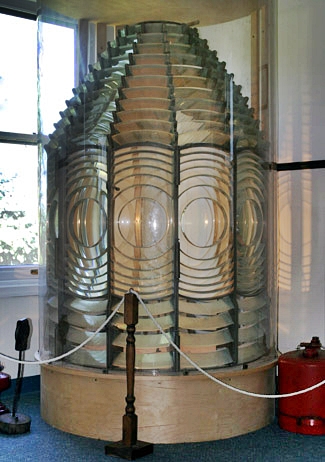
The ten-sided lantern room originally housed a third-order Fresnel lens manufactured by Barbier & Fenestre in Paris, France. This lens, which is now on display at the lighthouse, has twelve flash panels and revolved once in six minutes to produce a six-second flash every thirty seconds. The lens rested atop sixteen ball bearings and was rotated by a clockwork mechanism powered by a weight suspended in a drop tube located between the inner and outer walls of the tower.


Alfred B. Finch, a Civil War veteran, served as the first head keeper at Wind Point, and his son Asa served as the first assistant keeper. The light and fog signal were placed in operation on November 15, 1880, but after just a few days of operation, the revolving machinery for the light malfunctioned, and Alfred and Asa had to manually turn the lens for five frigid nights.


A brick fog signal building was constructed in 1900 to house duplicate, compressed-air sirens powered by oil engines. Two years later, two automatic Brown sirens, with copper trumpets were installed, and one of the two old wooden fog signal buildings was moved to the southwest part of the lot and converted into a woodshed. The characteristic of the fog signal was changed in 1906 from a three-second blast separated by twenty-seven seconds of silence, to a three-second blast separated by fifty-seven seconds of silence.


Thursday, August 13, 2026

Forest Bathing | Shinrin Yoku

https://www.youtube.com/watch?v=BqpUecF-6Vs&t=64s

Forest bathing is the practice of creating calm for your mind, body, and life through nature. By training the 5 senses we derive a range of benefits for our physical, mental, emotional, and social health. The Japanese word for forest bathing is Shinrin-yoku – ‘Shinrin’ means forest and ‘Yoku’ stands for bathing. In essence, it means immersing in the forest to becoming one with it.

After years of careful studies the Japanese came up with the concept of Forest Bathing in the 1980’s. Shinrin Yoku has proven to be a very effective tool in overcoming the negative effects of our modern lifestyles. Through a guided set of activities in the forest, we create inner calm, plant good health, and deepen our bonds with others.


Forest Bathing allows the stressed portions of your brain to relax. Positive hormones are released in the body. You feel less sad, angry and anxious. It helps to avoid stress and burnout, and aids in fighting depression and anxiety. A forest bath is known to boost immunity and leads to lesser days of illness as well as faster recovery from injury or surgery. Nature has a positive effect on our mind as well as body. It improves heart and lung health, and is known to increases focus, concentration and memory.

An intangible outcome of forest bathing with groups is improved relationships and better social health. Something that we know intuitively is now getting scientific proof and validation through research.


Certain trees like conifers also emit oils and compounds to safeguard themselves from microbes and pathogens. These molecules known as Phytoncides are good for our immunity too. Breathing in the forest air boosts the level of natural killer (NK) cells in our blood. NK cells are used in our body to fight infections, cancers and tumors. So spending time with these tree is a special form of tree bathing.

How To Forest Bathe

You can practise forest bathing in any safe nature space. The main principles are to go in silence and go slow. Use your senses to find things in nature that bring you peace and happiness. Through nature connection activities and sense exercises, you can alter your mood and energy levels resulting in a host of benefits. Recommended time for forest bathing is at-least 2 hours a week.


Sunday, May 24, 2026

Walkers Point Center for the arts,

For more than 38 years, Walker’s Point Center for the Arts has been a cultural staple of the Walker’s Point neighborhood and a powerful advocate for underrepresented artists in Milwaukee and beyond. As one of the city’s oldest and most beloved community art spaces, WPCA is renowned for providing high-caliber, accessible arts experiences for all — from bold exhibitions to youth arts programs. Like the neighborhood around it, WPCA is now entering a new phase of growth, one in which we believe the arts play an essential role in shaping responsible redevelopment and a shared, equitable vision for the future.


These images are what I chose for presentation.
Perhaps I could have chosen others.


Some view art differently than others.


These were taken on September 10, 2010

https://www.youtube.com/@meqphoto/videos


Thursday, May 7, 2026

SCUPPERNONG TRAILS

These trails, on County Highway ZZ just east of Highway 67 north of the Village of Eagle, are open for multi-uses...to hikers in the summer and in the winter although not groomed can be used by cross-country skiers, snowshoers and hikers. There are three color-coded loop trails ranging from just over 2 miles to 5 miles. The Scuppernong area provides convenient parking, water, and a vault toilet. There is an indoor shelter that can be rented in the summer.  It is a warming shelter in the winter. The trails have a nice rolling characteristic through hardwood forests and pine plantations. Hikers may also access the Ice Age National Scenic Trail from this trailhead. 

https://www.youtube.com/@meqphoto/videos

This is a wonderful opportunity for a forest adventure!


Wednesday, May 6, 2026


Beulah Bog lies in a series of four kettle holes and features an undisturbed bog with unusual plants more typical of northern bogs. Classical stages of ecological succession are exhibited in the bog including: a shallow bog lake dominated by water shield with white and yellow water-lilies and extensive floating mud flats; an advancing, quaking sedge and sphagnum mat between 25 and 50 feet wide; northern wet forest of tamarack and bog shrubs and; a wet open moat surrounding the main bog, dominated by wild calla and cat-tails. 

https://www.youtube.com/watch?v=sHvSz6vyDsQ&t=201s


Beulah Bog is owned by the DNR and was designated a State Natural Area in 1975.


Wednesday, April 22, 2026

Working with a new camera even though I have a pretty good iPhone.

These were taken with my Canon EOS R-100 camera with a fixed 50mm lens.

Minooka Park has a refreshingly tranquil atmosphere with trails that lead you farther from the city and further into nature. Most popular with the summer crowd is the swimming beach and pond. Enjoy a day at the beach or take a walk through the miles of wooded trails. Maybe you will catch a glimpse of the abundant spring ephemeral or variety of songbirds such as fly catchers or scarlet tanagers.


This was my first official outing on a fine Spring-like, March 9,2026.

I do enjoy editing my mages, using both Lightroom Classic And Luminar Neo.


I also add clouds when I feel the image needs it.


Even so, these trees were starting to bud.


WIND POINT LIGHTHOUSE

Built of brick with an inner and outer wall, Wind Point Lighthouse gradually tapers from a diameter of twenty-two feet at its base to twelve...